
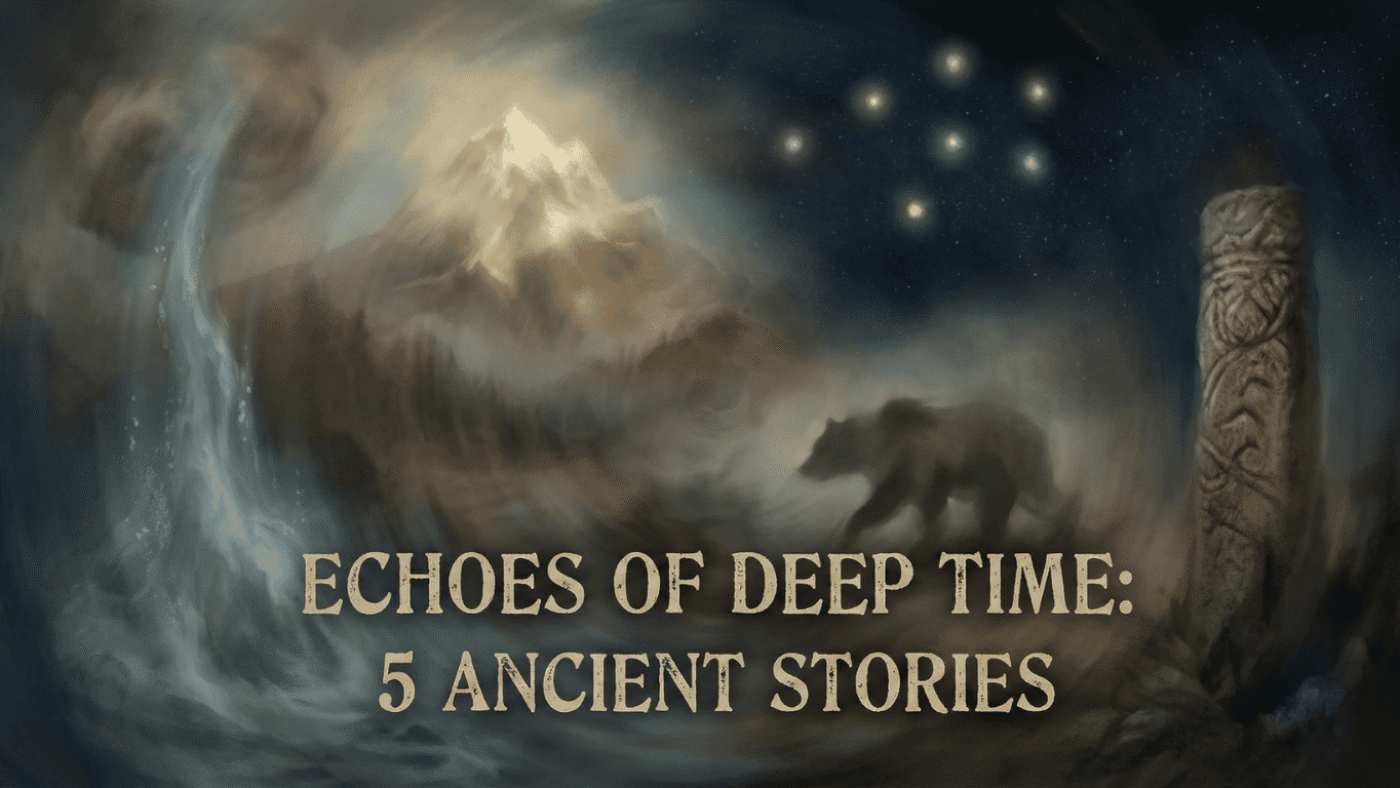
The Land That Became the Sea
Ten thousand years ago, the coastline of Australia looked very different. In the place we now call the Great Barrier Reef, there was no coral and no deep water. Instead, there was a wide, green plain stretched out under the sun. It was covered in eucalyptus forests and grassy fields. This was the home of the Gungganyji people.
A young boy named Birra lived there with his family. For them, the ocean was far away—a long journey to the east. They hunted kangaroo on the dry plains and camped near fresh rivers.
But slowly, something began to change.
It did not happen in a single day. The ocean did not crash down like a wall; it crept forward like a slow, hungry animal. Season after season, the high-tide mark moved closer to the camp. The river water, once sweet and fresh, turned salty. The trees at the edge of the forest turned brown and died as their roots drowned in the saltwater.
The elders of the tribe watched the horizon with worry. “The Great Water is rising,” Birra’s grandfather told him. “It wants the land back.”
Soon, the water swallowed their favorite hunting grounds. The valleys filled up to become bays. The tops of the hills were cut off from the mainland, turning into islands. The people had no choice but to pack up their camps and move inland, retreating to higher ground.
“We must remember this,” the grandfather said to Birra as they looked back at their sunken home. “You must tell your children that we once walked where the sharks now swim.”
Eventually, the water stopped rising. The drowned forest became the seabed, and the coral grew over the old land. But the Gungganyji people never forgot. They kept the story alive, passing it down from father to son for three hundred generations, remembering the time when the reef was a forest.
–
–
–
The Lost Sister of the Sky
A very long time ago, in the deepest past, the night sky looked different than it does today. In those nights, seven bright sisters danced together in the heavens. They were stars, glowing and beautiful, known as the Seven Sisters.
On earth, the people looked up and counted them: “One, two, three, four, five, six, seven.” Everyone could see all seven clearly. They were inseparable, twinkling close together in a small group.
But the sisters were not alone in the sky. Not far away stood a great hunter named Orion. He was powerful and bright, with a belt of three stars. Orion loved the seven sisters, but he was too aggressive. He chased them across the night sky, trying to catch them. Night after night, the chase continued—the sisters fleeing, and Orion following close behind.
One of the sisters, the youngest and shyest, grew tired of the chase. She was afraid of the hunter. She did not want to be seen.
Slowly, she moved closer to her older sister for protection. She stepped behind her sister’s bright light to hide. Over thousands of years, she moved so close that her light merged with her sister’s light. To the people watching from earth, it looked like she had disappeared.
The people looked up and counted again. “One, two, three, four, five, six…” They paused. “Where is the seventh sister?”
The elders told the children, “She is hiding. She is shy because the hunter is watching. Only those with the sharpest eyes can see her peeking out.”
Even though she was hidden, the people never changed the name. They still called them the Seven Sisters, honoring the memory of the lost star who hid herself away in the deep past, long before history began.
–
–
–
The Stone That Remembered the Fire
Long before cities were built or books were written, the world was a warm and green place. The people lived in the valleys of what is now Turkey. They hunted gazelles and gathered wild wheat, and life was good. They watched the stars every night, for the stars were their calendar and their gods.
But one year, a new light appeared in the sky.
At first, it was just a small, bright speck, like a guest who arrived uninvited. But night after night, it grew larger. It became a trail of fire that hissed across the heavens. Then, the terrible day arrived. The sky tore open with a roar that shook the mountains. The fire did not stay in the sky; it fell to the earth.
The ground rolled like ocean waves. Great clouds of dust and smoke rose up, blotting out the sun. For many weeks, the sun did not return. The air grew bitter cold. The animals fled or died, and the green valleys turned gray and frozen. The people huddled in caves, terrified that the world was ending. They called this the time of the Great Cold.
When the dust finally settled and the survivors could walk outside again, the elders made a decision. “We must not forget this,” they said. “We must tell the people of the future when the sky fell.”
They climbed to the top of a high hill—a sacred meeting place we now call Göbekli Tepe. There, they cut huge blocks of limestone from the earth. They dragged these massive pillars into a circle, standing them upright like sentinels guarding a secret.
The master carver chose the most important stone, which we know today as Pillar 43. He did not have an alphabet, so he used the language of the sky. He looked up at the constellations that were visible during the disaster.
He carved a scorpion, sharp and dangerous. He carved a great vulture, the bird of death, spreading its wings over the stone. Beside the vulture, he carved a headless man, a symbol of the terrible loss of life they had suffered. These were not just animals; they were a map of the stars. The carver was freezing the sky in stone, marking the exact date of the catastrophe.
“This is our message,” the carver thought as his stone chisel chipped away at the limestone. “When the stars look like this again, remember the fire.”
When the temple was finished, the people did something strange. They did not live in it. Instead, they carefully buried the entire site with dirt and rubble. They hid their story beneath the earth to protect it from the wind and rain.
For twelve thousand years, the Vulture Stone slept in the dark. Civilizations rose and fell. Empires crumbled. Finally, in our modern time, we dug up the hill and found the pillar standing exactly where the carver left it. We looked at the animals and the headless man, and we understood. The people of the past were reaching out across time, warning us that the sky can change in an instant.
–
–
–
The Great Bear Hunt
In the oldest times, when the ice covered the northern lands and winter was long, there was a great bear. This was no ordinary bear; he was massive and magical, wandering through the forests of the night.
Three brothers, who were the best hunters in their tribe, spotted the bear’s tracks. “We must catch him,” the eldest brother said. “He will feed our village for the whole winter.”
They grabbed their spears and began the chase. The bear was fast, crashing through the trees and bounding over frozen rivers. But the brothers were determined. They ran for days, never stopping to rest, their eyes fixed on the great beast.
The bear realized he could not outrun them on the earth. He was tired, and the hunters were getting closer. He reached the edge of the world where the mountains touched the sky. With a mighty roar, the bear leaped up from the peak of the mountain and jumped straight into the heavens.
The hunters did not hesitate. They were so focused on the hunt that they leaped into the sky right after him. They did not fall back down. Instead, they turned into stars.
To this day, you can see them. The four stars of the bowl form the great bear. The three stars of the handle are the three hunters, chasing him forever across the night.
But the story does not end there. Every autumn, as the sun begins to fade, the hunters get close enough to wound the bear. Their arrow strikes him, and a drop of his blood falls from the sky down to the earth.
This magical blood lands on the leaves of the trees below. It turns the maple and the oak leaves red and brown. This is why the forest changes color every fall.
But the bear does not die. As winter comes, he heals and moves low in the sky to hibernate. When spring returns, the bear wakes up, and the eternal chase begins all over again.
–
–
–
The Giant Who Spat Fire
A very, very long time ago—long before the pyramids were built, and even before the last Ice Age covered the world in cold—the land of southeastern Australia was different. It was the home of the Gunditjmara people. They lived on the earth, hunting and gathering, watching the sun rise and set over a peaceful land.
But the earth was waiting for something to happen.
One day, four great beings appeared on the horizon. These were not men; they were giants, powerful creators who walked across the country with heavy steps. They wandered the land, looking for a place to rest. Three of the giants moved on, walking to other parts of the country, but the fourth giant stopped. His name was Budj Bim.
He looked at the flat earth and decided he would stay there. He crouched down low, his massive body becoming the shape of a mountain. But something inside him was burning. He was not made of cool stone; he was made of fire.
Suddenly, Budj Bim opened his mouth. The storytellers say that his teeth were not white like ours. They were glowing, red and orange, hotter than any campfire. As he opened his jaws, his burning teeth spilled out of his mouth.
This was not just a story; it was a volcano erupting.
The “teeth” were molten lava. The liquid rock poured over the giant’s lips and flowed down his sides. It hissed and roared, moving like a river of fire across the green grass. The Gunditjmara people saw the smoke rising and felt the ground shaking beneath their feet. They saw the glowing river coming toward them and knew they had to run.
They fled to safety, watching from a distance as the fire covered their hunting grounds. The lava flowed far and wide, changing everything it touched. It filled the valleys and blocked the rivers.
When the fire finally cooled down, the land was changed forever. The hot “teeth” turned into hard, black rocks. These rocks created a complex system of channels, wetlands, and ponds.
The people returned to this new landscape. They did not forget the giant. They learned to build fish traps in the hard black rocks that Budj Bim had spat out. And for thirty-seven thousand years, grandfathers told their grandsons: “Walk carefully here. This is the place where the Giant crouched down and spat his fiery teeth onto the ground.”
Leave A Comment